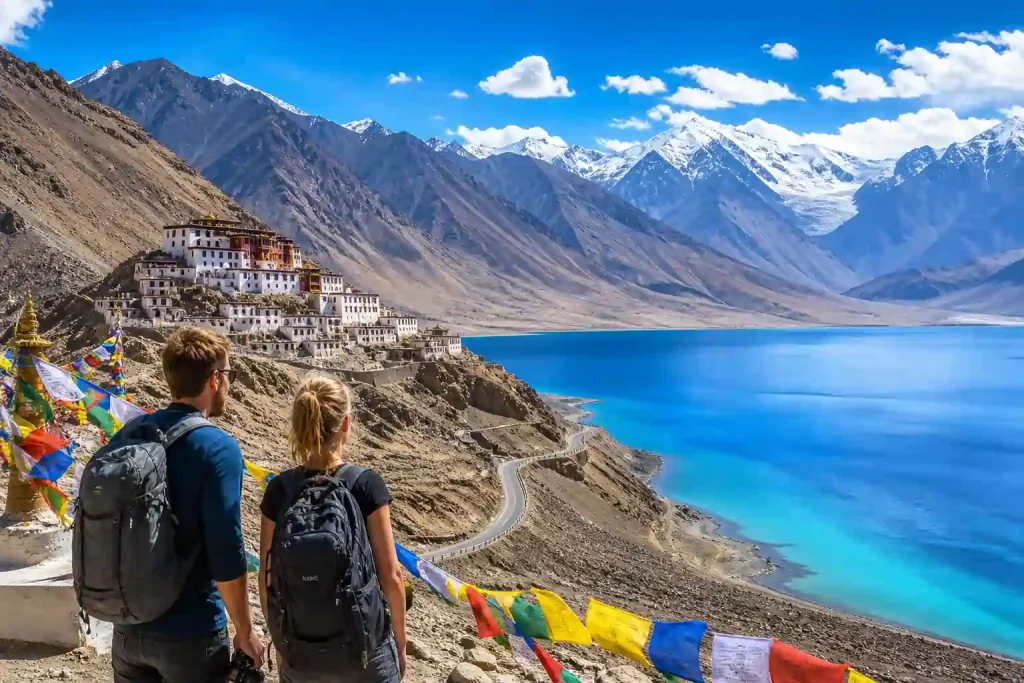
Ladakh, India:
The Roof of the World
The complete honest 2026 guide for American travelers — Pangong Lake’s impossible blue, Nubra Valley’s camel dunes, Buddhist monasteries at 4,000 metres, altitude sickness explained, the permit system for foreigners, costs, and a 7-day itinerary for the most dramatic landscape in India.
Ladakh is the India that looks like the moon. High, cold, treeless, and coloured in browns and ochres and silvers, cut through by rivers of impossible turquoise — it is the planet’s high-altitude desert, the kind of landscape that makes grown adults stop mid-sentence and forget what they were saying.
Set in the far north of India between the Karakoram and Himalayan mountain ranges, Ladakh is a place that the rest of India feels very far from. The air is thin — Leh city sits at 3,524 metres (11,562 feet), higher than any point in the continental US outside Alaska. The sky is the deepest blue you will ever see. The monasteries are ancient and still functioning. And the road to Pangong Lake — the three-hour drive across 5,000-metre passes to one of the world’s highest and most beautiful lakes, its waters cycling through greens and blues and silvers depending on the angle of the sun — is one of the great drives in Asia.
Americans have been falling in love with Ladakh since the 1970s, when the first adventurous Westerners made the overland journey to Leh. Today it is more accessible than ever — a one-hour flight from Delhi — while remaining genuinely wild, genuinely remote, and genuinely unlike anywhere else in India. The altitude and permit requirements add logistical complexity that this guide fully explains. The reward for the preparation is one of the most extraordinary landscapes available to any traveler on Earth.
“Ladakh does to your sense of scale what nothing else in India manages. You stand at the edge of Pangong Lake and understand, for the first time, what truly vast actually means.”
— Mumbai7.com Travel Desk, 2026June–September is the main season: all roads open, all passes accessible, best weather. July–August sees some rain (Ladakh’s “monsoon”) but far less than the rest of India. September is the sweet spot — clear skies, slightly cooler, thinner crowds.
Altitude Sickness (AMS) — Read This Before Everything Else
Altitude sickness — Acute Mountain Sickness (AMS) — is the single most important thing to understand before visiting Ladakh. It is not a sign of weakness or poor fitness. It is a physiological response to reduced oxygen at high altitude that affects athletes and couch potatoes equally. It has ended Ladakh trips for many well-prepared, fit American travelers who underestimated it.
Leh sits at 3,524 metres — higher than any point in the continental United States. When you fly from Delhi (214m) to Leh (3,524m) in 55 minutes, your body has no time to adjust. The 48-hour acclimatization rule is not a suggestion — it is enforced by the Leh District Administration in 2026 as a precondition for permit issuance. You cannot get your area permits until 48 hours after your arrival in Leh.
Recognising AMS Symptoms — The Three Levels
Headache (most common), fatigue beyond normal tiredness, slight nausea, loss of appetite, dizziness on standing, disturbed sleep. Usually appears 6–12 hours after arrival.
Severe headache unresponsive to painkillers, persistent vomiting, extreme fatigue, difficulty walking straight, reduced urine output, shortness of breath at rest.
Confusion or altered consciousness, inability to walk, persistent cough with pink frothy sputum, extreme shortness of breath at rest. Signs of HACE or HAPE.
How to Prevent Altitude Sickness — 7 Rules
- Fly to Leh, do not drive: Flying is paradoxically safer — the Manali-Leh road (passing 5,000m+ passes) takes 2 days and gives your body less time to adjust than flying in and resting.
- Rest completely on Day 1: Sleep, read, sit quietly. No sightseeing, no walks up hills, no alcohol. Your body needs every joule of energy to produce red blood cells.
- Drink 3–4 litres of water daily: Dehydration severely worsens AMS. Carry a water bottle at all times. The dry Ladakhi air increases fluid loss dramatically.
- No alcohol for the first 48 hours: Alcohol at altitude dramatically worsens AMS and disrupts the oxygen-carrying capacity of your blood.
- Ask your doctor about Diamox (Acetazolamide): This prescription medication speeds acclimatization and significantly reduces AMS risk. Take it before you fly to Leh. Common side effects include increased urination and tingling in fingers. Not suitable for everyone — consult your physician 4+ weeks before travel.
- Ascend gradually: “Climb high, sleep low” is the mountaineer’s rule. Day trips to higher altitudes are fine; sleeping at a significantly higher altitude than you’ve been at is the risk.
- Know when to go down: There is no shame in descending. Descent is the cure. One American traveler who descends from Pangong to Leh and rests for a day can return to full health. One who ignores worsening symptoms can die. This is the rule.
🚨 Critical 2026 rule: The Leh District Administration now enforces a mandatory 48-hour stay in Leh before permits are issued. The online portal will not generate your permit receipt until 48 hours have elapsed since your airport check-in scan. This rule exists because too many travelers were rushing straight to Pangong Lake on Day 1 and needing helicopter evacuation. Respect it. Use the two days to acclimatize properly — your entire Ladakh experience will be better for it.
Permits for American Travelers — The 2026 System Explained
This is the section most existing guides get wrong or leave incomplete. The permit system for foreign nationals in Ladakh is different from the system for Indian citizens — and it is stricter. Here is the complete, accurate picture for 2026.
Protected Area Permit (PAP) — Required for All Americans
All foreign nationals and NRIs holding PIOs or OCIs require a Protected Area Permit (PAP) to visit Inner Line Regions of Ladakh including Pangong Tso, Nubra Valley, Khardung La, Tso Moriri, Turtuk, and Dah Hanu villages. This is separate from the Environment Fee system that replaced the ILP for Indian citizens.
📋 How Americans get their PAP in 2026:
1. Apply through a registered travel agent in Leh — most quality hotels and guesthouses in Leh can recommend one, and many handle this for their guests as a standard service.
2. Apply at the DC Office (Deputy Commissioner’s Office) in Leh — bring your passport, 2 passport photos, a photocopy of your passport bio page and Indian visa, and the required fee (approximately ₹400–560 + processing).
3. You must be in a group of 2 or more — solo foreign travelers cannot get a PAP. If you are traveling alone, connect with another foreign traveler in Leh (very easy to do at any guesthouse or cafe) to apply together.
4. Processing time: Same day in most cases. Apply in the morning and collect by afternoon.
5. 48-hour rule: The 48-hour mandatory Leh stay before permit issuance applies equally to foreign nationals. Plan accordingly — Day 1 and Day 2 are in Leh, permits collected on Day 2 afternoon or Day 3 morning.
⚠️ Important for solo American travelers: If you are traveling alone, you cannot obtain a PAP independently. The requirement for a group of 2+ can be met by pairing with any other foreign traveler — not necessarily your nationality or itinerary. The Leh traveler community is remarkably friendly and this pairing happens informally at guesthouses, cafes, and the DC Office itself every day. Ask your guesthouse or the DC Office — they will help connect you.
Ladakh’s Essential Destinations — What They Are and Why They Matter
Ladakh is not a single destination but a region of distinct valleys, each with its own altitude, character, and wildlife. These are the six that every American should know.
If you have seen one photograph of Ladakh that made you want to come, it was almost certainly Pangong Lake — a 134-kilometre-long high-altitude lake at 4,350 metres that shifts through an impossible range of blues, greens, and silvers depending on the time of day, cloud cover, and angle of light. No photograph adequately prepares you for its actual colour. The lake extends into China; the Indian-controlled portion is roughly 40% of its total length.
The three-hour drive from Leh via Chang La Pass (5,360m) is an experience in itself — through moonscape valleys, across high-altitude plains, past nomadic camps and barley fields at impossible altitudes. Spend at least one night at the lake. The sunrise colours and the absolute silence of a Pangong morning are worth the drive alone.
The road from Leh to Nubra Valley crosses Khardung La — once claimed as the world’s highest motorable road at 5,359 metres (now verified at around 5,359m, still extraordinary). The valley below — carved by the Shyok and Nubra rivers — is a cold desert with sand dunes surrounded by 7,000-metre peaks. Double-humped Bactrian camels roam the dunes at Hunder village. The combination of alpine scenery and Saharan sand dunes, with snow peaks in every direction, is something that the human brain has trouble reconciling. It doesn’t look real. It is.
Leh is the capital and only city of Ladakh — a high-altitude market town with a Tibetan Buddhist character, a busy bazaar, excellent cafes, guesthouses, and tour operators catering to international visitors. The old town below Leh Palace has been inhabited continuously since the 2nd century BC. The Tibetan Buddhist culture — evident in the prayer flags on every rooftop, the monks in maroon robes in the market, and the sound of monastery horns at dawn — gives the city an atmosphere quite unlike any other in India.
Further from Leh and less visited than Pangong, Tso Moriri is a high-altitude lake (4,522m) in the Changthang plateau that many experienced travelers prefer to Pangong — quieter, surrounded by higher peaks, with a small Changpa nomad village on its shore and extraordinary birdlife including bar-headed geese and black-necked cranes. The road there is longer (4–5 hrs from Leh) and more demanding, which keeps it remote. PAP required.
Ladakh has 108 monasteries (gompas), many of them dating to the 12th–15th centuries. The two finest for first-time visitors are Thiksey — a 12-floor monastery complex rising above the Indus Valley that resembles the Potala Palace in Lhasa — and Hemis, the largest and wealthiest monastery in Ladakh, home to a famous annual festival of masked dances in June/July. Both are within 45 minutes of Leh and require no special permit.
For Americans who want to go deeper, Zanskar Valley — accessible from Leh via a dramatic highway — offers some of the world’s most extraordinary trekking including the famous Markha Valley Trek (5–7 days) and the Chadar Trek (the winter frozen-river walk, January–February only). The valley has Buddhist villages, turquoise rivers, and 6,000-metre peaks in every direction. Requires additional planning, permits, and a competent local guide.
The Perfect 7-Day Ladakh Itinerary for Americans
This itinerary is built around the mandatory 48-hour Leh acclimatization and maximises the Pangong + Nubra circuit within 7 days. Days 1–2 are critical and non-negotiable.
Ladakh Budget for Americans — 2026
Ladakh is mid-range priced by Indian standards — slightly more expensive than the plains due to its remoteness and transport costs. Here is an honest per-day breakdown.
| Category | Budget | Mid-Range | Luxury | Notes |
|---|---|---|---|---|
| Accommodation (per night) | $10–25 | $40–100 | $150–400 | Leh guesthouses excellent value. Pangong/Nubra camps: $30–120. Luxury glamping available at both lakes. |
| Private cab per day | Share: $10–20 | Private: $40–80 | Premium SUV: $80–150 | Private cab is the standard. Shared cabs available from Leh taxi stand. All cab prices set by taxi union — not negotiable. |
| Food | $5–10/day | $15–30/day | $40–80/day | Leh cafes have excellent food at very reasonable prices. Thupka (noodle soup) and momos are local staples at $2–4. |
| PAP Permit (Americans) | ~$10 total | ~$10 + agent fee $15–25 | Handled by lodge | PAP fee itself is minimal. Travel agent processing adds $15–25. Most mid-range and luxury lodges include this in their services. |
| Pangong overnight camp | $20–35 | $60–100 | $150–300 | Includes dinner and breakfast. Book in advance June–September. Stars at Pangong at night are extraordinary from any camp tier. |
| Activities | $5–15 | $20–50 | $50–150 | Camel ride Hunder: ₹300–500. Monastery entries: ₹50–100. White water rafting Zanskar: ₹1,500–2,500. |
| Total Per Day (7-day trip) | $40–70 | $100–180 | $250–500 | 7-day Ladakh: $450–$5,000 depending entirely on accommodation and transport choices |
How to Reach Ladakh from the US and Major Indian Cities
✈️ Always confirm your Leh flight the evening before. Mountain weather cancellations are common — cloud cover over the Himalayan approach can ground all flights for a day. Build a 1-day buffer before any important onward connection from Delhi. Many experienced Ladakh travelers book refundable train or bus backup options from Delhi in case their Leh flight is cancelled.
What to Pack for Ladakh — Complete List
Ladakh’s climate is extreme: days can reach 25°C in June–August, nights drop to 0–5°C at Leh and -5°C at Pangong. At 5,000m passes, the temperature can be below freezing in any season. Pack for all of this.
- Diamox (Acetazolamide) — prescribe before travel
- Ibuprofen and Paracetamol
- Rehydration salts (ORS sachets)
- SPF 50+ sunscreen (mountain UV is extreme)
- UV-blocking wraparound sunglasses
- Lip balm with SPF
- Basic first aid kit
- Hand sanitiser and wet wipes
- Down jacket (essential for passes and nights)
- Fleece mid-layer × 2
- Thermal base layers × 2 sets
- Wind and waterproof outer shell
- Lightweight trekking trousers × 2
- Long-sleeve moisture-wicking shirts × 3
- Warm hat covering ears
- Gloves (light)
- Sturdy walking shoes or trail runners
- Offline maps downloaded (Maps.me for Ladakh)
- Power bank (electricity cuts are common)
- Universal adapter
- BSNL SIM (only network in remote areas)
- Passport + 2 photocopies
- Indian e-visa printout
- 2 passport photos for PAP application
- Cash ₹15,000+ (ATMs unreliable in remote areas)
10 Essential Tips for Americans Visiting Ladakh
The single most important daily practice. The dry Ladakhi air and your body’s altitude-adjustment process both consume water at rates dramatically higher than sea level. Three to four litres per day minimum. Your urine should be nearly clear — pale yellow is acceptable, dark yellow means drink more immediately. Carry a refillable bottle and refill constantly.
Leh has ATMs that generally work. Beyond Leh — at Pangong, Nubra, Tso Moriri — ATMs are nonexistent and digital payments are largely unavailable. Mobile networks are limited and ATMs in remote areas may not work reliably. Withdraw ₹15,000–20,000 in Leh before leaving for any outstation trip. All camps, camel rides, and local restaurants are cash-only.
Airtel and Jio have virtually no signal beyond Leh city. Only postpaid SIMs work in most areas of Ladakh — and among those, BSNL is the most reliable. Get a BSNL SIM at the Leh market before any outstation trip. Download offline maps before leaving Leh — Maps.me with Ladakh downloaded is essential. Assume you will have no signal for the majority of your Pangong and Nubra visits.
UV radiation increases approximately 10% per 1,000 metres of altitude. At 5,000m you are receiving UV levels 50% higher than at sea level. Sunburn on exposed skin takes 20–30 minutes, not hours. Apply SPF 50+ every two hours. Wear a full-brim hat. Wrap-around UV-blocking sunglasses are essential — snow blindness from reflected UV is a genuine risk at snow-covered passes.
Leh’s taxi pricing is set by the official taxi union — rates are fixed and non-negotiable, and attempting to negotiate significantly lower can cause offense. You cannot use your own hired vehicle for certain route combinations — the union has territorial divisions between Leh, Nubra, and Pangong operators. Ask your guesthouse to help arrange the right combination of taxis for your itinerary. The system is established and works.
Even after two days in Leh, never ascend to a significantly higher altitude without spending a night at an intermediate level first. The rule is: climb high, sleep low. A day trip to Khardung La (5,359m) returning to sleep in Leh (3,524m) is fine. Sleeping at Pangong (4,350m) on your first day out of Leh is not. Your body needs time at each level.
The “golden hours” at altitude are extraordinary — the light quality at Pangong and Nubra between 5–8 AM and 5–7 PM is unlike anywhere else in India. The midday light at altitude is harsh and washes colour from the landscape. Plan your most important shots for dawn and dusk. At Pangong, the pre-dawn colour on the mountains reflected in the lake at 5:30 AM is the finest natural photography opportunity in India.
Ladakh is a deeply Buddhist region. Walk clockwise around all stupas and prayer wheels — the direction matters. Remove shoes before entering monastery prayer halls. Ask permission before photographing monks or religious ceremonies. Do not sit with feet pointing toward altars or sacred objects. Dress modestly at religious sites. The monastic culture here has survived for 1,000 years — treat it accordingly.
Ladakh has some of the lowest light pollution in Asia. At Pangong Lake (4,350m) with zero nearby settlement and clear mountain air, the Milky Way is visible as a complete band across the sky — a sight most Americans have never seen from the continental US. Set an alarm for 2 AM on your Pangong night. Bring a blanket to the lakeshore. Allow 20 minutes for your eyes to fully adapt. This is one of those things you cannot unsee.
Mountain weather in Ladakh can change completely in minutes — passes can close in sudden snowfall even in July, roads can be blocked by rockfall or flooding, and flights can be cancelled for days by cloud cover. Build buffer days on both ends of your Ladakh trip. Do not make tight connections in Delhi after Leh — many experienced travelers miss international flights because of a single-day Leh weather delay. Book fully refundable accommodation on both sides.
Government Official Website – https://ladakh.gov.in/

Leave a Reply