The Banyan tree is the National Tree of India. The uncommon name of this tree is the ‘Indian Fig Tree‘. It is found in almost all places in India, especially near Temples.

The leaves of the Indian Fig tree are large, leathery, glossy, and dark green. The young leaves of the tree have a unique reddish tinge.
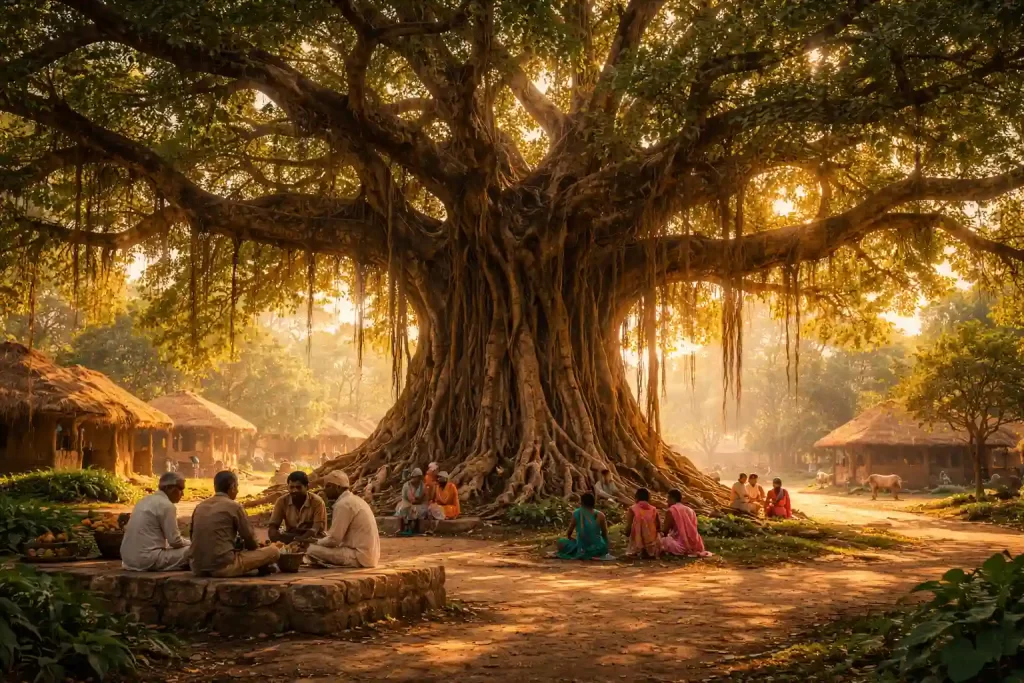
Older banyan trees have thick, woody trunk that grows bigger with age. The tree roots grow all over the tree and appear to be spread their reach as far as possible.
Some famous Banyan Trees in India:
- 550-year-old banyan tree is in the Indian Botanical Garden in Andra Pradesh.
- 500-year-old large banyan tree, Kalpabata, is situated on the premises of Jagannath Temple in Puri and is considered sacred.
- 250-year-old and the most giant Banyan trees are situated in Kolkata and cover around 4.67 acres
- The Thimmamma Marrimanu is the world’s giant Banyan tree and was listed in the Guinness Book of World Records in 1989. It is about 35 km from ‘Kadri Lakshmi Narsimha temple’ in the Anantapur district of Andhra Pradesh. It is spread over 5 acres, and its canopy stretches to about 19,107 sq. meters.

The Vat, Bargad (Banyan tree) is the most worshiped tree in India. It can survive and grow for centuries and is considered the shelter given by God to his people.
As per Hindu mythology, the tree is referred to as Kalpavriksha.
The Banyan tree symbolizes Trimurti:
- The bark is believed to be Lord Vishnu
- The roots are believed to be Lord Brahma
- The branches are believed to be Lord Shiva
Ancient scriptures mention the Banyan tree as the tree of immortality. The roots emerge from the top of the tree and go down into the soil, forming additional trunks and growing this way for hundreds of years. Hence its symbolizes longevity and represents Bramha, the divine creator.

The leaves, branches, buds, and barks are used for medicinal purposes.
History of Vat Savitri Puja :
Women in India are seen tying cotton threads on the trunk of this tree. They perform this sacred ritual and pooja on Vat Savitri Puja. This is done somewhere around May and June.
This practice is based on the famous belief of Satyavaan Savitri. It is said that Satyavaan was breathing his last breath under the banyan during the full moon in Jyeshta. This is when the God of death, ‘Yama Raja,’ came to take his soul.
Sayavaan’s wife, Savitri pleaded to Yama to return her husband’s soul. At first, Yama disagreed, but Savitri managed to convince him to return her husband’s life.
To commemorate this mythology event, women in India fast the entire day and tie a cotton thread on the trunk of the banyan tree by circling it 108 times and praying for the long healthy life of their husbands.
The Bodhi tree is the banyan tree under which Gautama Buddha meditated and attained enlightenment.
The banyan tree symbolizes Longevity, Power, Grace, and Divinity and therefore is the National Tree of India.
Frequently Asked Questions About the National Tree of India
What is the national tree of India?
The banyan tree (Ficus benghalensis) is the national tree of India. It was chosen because of its long lifespan, massive canopy, and deep cultural significance in Indian society. The banyan tree symbolizes strength, longevity, and unity.
Why is the banyan tree the national tree of India?
The banyan tree was selected as the national tree because it represents immortality, wisdom, and community life. Its wide-spreading branches and aerial roots symbolize how India’s diverse cultures remain connected and grow together as one nation.
What makes the banyan tree unique?
The banyan tree is unique because its branches produce aerial roots that grow downward into the soil and form new trunks. Over time, a single banyan tree can spread over a very large area, creating the appearance of a small forest.
Where are banyan trees commonly found in India?
Banyan trees are commonly found in villages, temples, parks, and rural areas across India. They often serve as community gathering spots where people meet, rest, or hold discussions under the shade of the tree.
What is the scientific name of the banyan tree?
The scientific name of the banyan tree is Ficus benghalensis. It belongs to the fig family, Moraceae, and is native to the Indian subcontinent.
Why is the banyan tree important in Indian culture?
The banyan tree has great cultural and spiritual importance in India. It appears in ancient scriptures, religious traditions, and folklore. Many people consider it sacred, and it is often associated with longevity, stability, and wisdom.
What is the name of the National Tree of India in various languages?
| Language | Name |
| English | Banyan Tree |
| Tamil | Aala |
| Malayalam | Aalu / Peeralu |
| Telugu | Marri |
| Kannada | Aalada Mara |
| Hindi | Barh, Bad, Baragada |
| Bengali | Bot |
| Gujarati | Wad |
| Konkani | Vodacho Ruk |
| Marathi | Wad / Vada |
| Oriya | Bara |
| Punjabi | Barh |
| Tulu | Goalimara |
National Tree of India in Hindi (भारत का राष्ट्रीय वृक्ष हिंदी में)
बरगद का पेड़ (फिकस बेंगलेंसिस) भारत का राष्ट्रीय वृक्ष है। इस पेड़ का असामान्य नाम ‘इंडियन फिग ट्री’ है। यह भारत में लगभग सभी जगहों पर पाया जाता है, खासकर मंदिरों के पास।
भारतीय अंजीर के पेड़ की पत्तियाँ बड़ी, चमड़े की, चमकदार और गहरे हरे रंग की होती हैं। पेड़ की युवा पत्तियों में एक अद्वितीय लाल रंग का रंग होता है।
पुराने बरगद के पेड़ों में एक बड़ा मोटा और लकड़ी का तना होता है जो केवल उम्र के साथ बड़ा होता जाता है। पेड़ की जड़ें पूरे पेड़ पर उगती हैं और जहाँ तक संभव हो अपनी पहुँच फैलाती हुई दिखाई देती हैं।
भारत में कुछ प्रसिद्ध बरगद के पेड़
- 550 साल पुराना बरगद का पेड़ आंध्र प्रदेश राज्य में भारतीय वनस्पति उद्यान में है।
- 500 साल पुराना बड़ा बरगद का पेड़, कल्पबाटा, पुरी में जगन्नाथ मंदिर के परिसर में स्थित है और पवित्र माना जाता है।
- 250 साल पुराने और सबसे बड़े बरगद के पेड़ कोलकाता में स्थित हैं और लगभग 4.67 एकड़ में फैले हुए हैं।
- थिम्मम्मा मर्रीमनु दुनिया का सबसे बड़ा बरगद का पेड़ है और इसे वर्ष 1989 में गिनीज बुक ऑफ वर्ल्ड रिकॉर्ड में सूचीबद्ध किया गया था। यह ‘कादरी लक्ष्मी नरसिम्हा मंदिर’ से लगभग 35 किमी दूर है जो आंध्र प्रदेश के अनंतपुर जिले में है। यह 5 एकड़ में फैला हुआ है और इसकी छतरी लगभग 19,107 वर्ग मीटर तक फैली हुई है।
- वट, बरगद (बरगद का पेड़) भारत में सबसे ज्यादा पूजा जाने वाला पेड़ है। यह सदियों तक जीवित और विकसित हो सकता है और इसे भगवान द्वारा अपने लोगों को दिया गया आश्रय माना जाता है।
- हिंदू पौराणिक कथाओं के अनुसार, पेड़ को कल्पवृक्ष के रूप में जाना जाता है।
बरगद का पेड़ त्रिमूर्ति का प्रतीक है:
- इसकी छाल को भगवान विष्णु माना जाता है
- जड़ों को भगवान ब्रह्मा माना जाता है
- शाखाओं को भगवान शिव माना जाता है
Also Read: The History of India

Leave a Reply