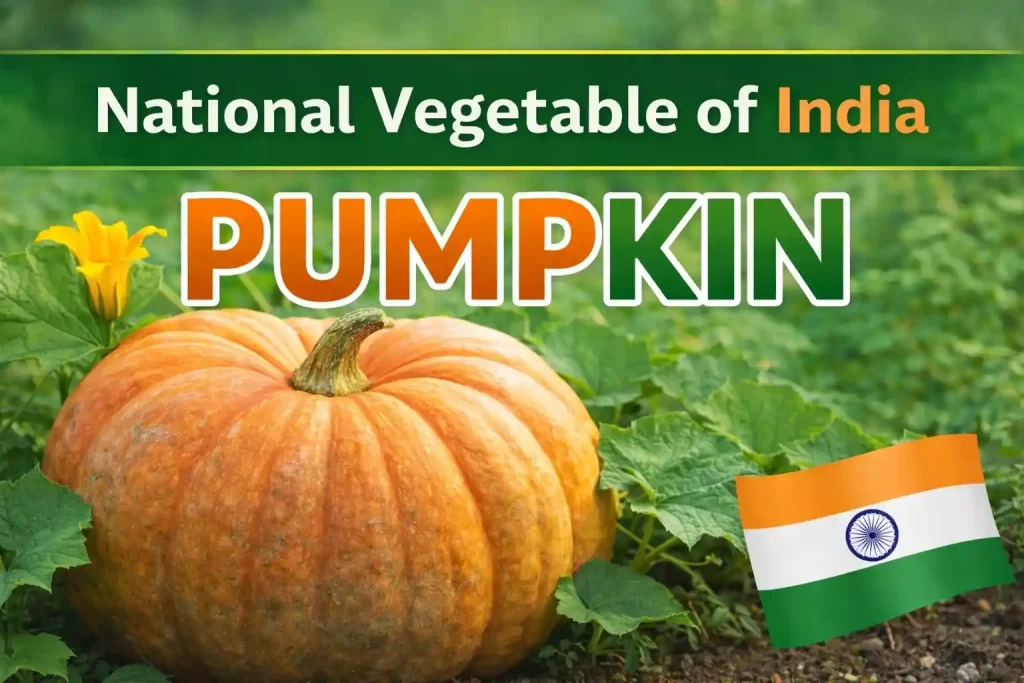
The National Vegetable of India is popularly said to be the Indian Pumpkin, known as “Kaddu” in Hindi. However, this is not an official government title — India has never formally notified a national vegetable. Pumpkin earned the unofficial title because it grows in almost every state, needs no special soil, and appears in everyday meals, festivals, and religious rituals across the country.
Quick fact check: The Government of India’s official list of national symbols — flag, anthem, animal (Bengal tiger), bird (Indian peafowl), flower (lotus), fruit (mango), tree (banyan) — does not include a national vegetable. Pumpkin’s status is a widely repeated popular belief, not a Gazette notification. We’re flagging this upfront because most articles online skip it.
What Is the Indian Pumpkin?
Indian Pumpkin refers to gourds from the genus Cucurbita, mainly Cucurbita maxima and Cucurbita moschata, grown widely across India. It’s often confused with squash and bottle gourd, but pumpkin is distinct in its thick ribbed rind, dense orange flesh, and flat white seeds.
The fruit starts out green and turns orange or deep yellow as it ripens. Skin color ranges from pale green to near-black green depending on sun exposure during growth, while the inside holds soft orange pulp and a cluster of edible white-cased seeds.
Why Is Pumpkin Called India’s National Vegetable?
Even without official status, a few practical reasons explain why pumpkin picked up the title:
- Grows almost anywhere — it tolerates poor soil, needs little water once established, and climbs or creeps along fences and rooftops, making it viable even for small kitchen gardens.
- Affordable and abundant — because it’s easy to cultivate, pumpkin has historically been called a “poor person’s vegetable,” feeding families cheaply during lean seasons.
- Everywhere in Indian cuisine — from North Indian kaddu ki sabzi to Kerala’s coconut-based erisheri and Bengal’s fried pumpkin flowers, it appears in nearly every regional kitchen.
- Deep ritual significance — it’s central to Ganesh Chaturthi offerings, Navratri and Diwali cooking, and regional customs (more on this below).
Origin and History in India
Cucurbita species were domesticated in the Americas thousands of years ago and reached India through early trade routes, adapting quickly to the subcontinent’s tropical and subtropical climates. Southern India is generally credited as the region where pumpkin cultivation first took strong root locally, spreading north over centuries as farmers found it reliable in both black cotton soil and sandy loam.
Because it required no irrigation infrastructure and stored well after harvest, pumpkin became a food-security crop for rural households — planted near homes so families always had something to fall back on during droughts or off-seasons.
Popular Varieties of Indian Pumpkin
| Variety | Key Traits | Best Used For |
|---|---|---|
| Arka Suryamukhi | Orange skin, sweet white flesh, similar to butternut squash | Curries, raw salads |
| Arka Chandan | Medium size (2–3 kg), light brown skin, notably sweet | Everyday home cooking |
| PAU Magaz Kaddu-1 | Medium, round, turns yellow on ripening | Eating raw/lightly cooked |
| Punjab Samrat | Small, green skin, high pulp content | Baking, pies |
| PPH-1 | Dwarf vine, small and round, mild sweetness | Spiced curries |
| PPH-2 | Fast-growing, medium size, less flesh | Soups, stews |
Nutritional Profile of Pumpkin (per 100g, cooked)
| Nutrient | Approx. Amount |
|---|---|
| Calories | ~20 kcal |
| Fiber | ~1 g |
| Vitamin A | Very high (from beta-carotene) |
| Vitamin C | Moderate |
| Potassium | ~230 mg |
Values are approximate and vary by variety and cooking method. Not a substitute for professional nutrition advice.
Health Benefits of Eating Pumpkin
- Supports digestion and weight management — low in calories and reasonably high in fiber for its weight, so it can help with satiety when part of a balanced diet.
- Good for eyes — rich in beta-carotene, which the body converts to vitamin A, important for night vision.
- Antioxidant support — carotenoids in pumpkin are linked to reduced oxidative stress, which plays a role in skin and cell health.
- Heart-friendly nutrients — potassium and fiber content support healthy blood pressure and cholesterol management as part of an overall balanced diet.
- Immune support — vitamin A and C content contribute to normal immune function.
This is general nutritional information, not medical advice. Speak to a doctor or dietitian for guidance specific to your health.
Pumpkin in Indian Festivals and Rituals
Pumpkin shows up in religious and cultural life far more than most vegetables:
- Ganesh Chaturthi — offered during puja as a symbol of prosperity, tied to Lord Ganesha.
- Diwali and Navratri — used in festive cooking and, in some regions, as decorative offerings.
- Chhattisgarh — cutting a pumpkin is treated with real ceremony in some households, with a male family member traditionally making the first cut before it’s handed to the women of the house for cooking.
- West Bengal and parts of North India — pumpkins are sometimes used as a symbolic substitute in place of animal sacrifice during certain rituals.
- South India — in some communities, a white pumpkin is hung outside the home, believed to absorb negative energy; if it lasts a full year without rotting, it’s taken as a good sign.
How Pumpkin Is Eaten Across India (and the World)
Regional cooking styles turn the same vegetable into very different dishes:
- North India — kaddu ki sabzi, a mildly spiced, slightly sweet-sour curry.
- Kerala — erisheri, a coconut-and-lentil pumpkin stew, and pumpkin-based halwa snacks.
- Tamil Nadu — pumpkin cooked into sambar or paired with rice.
- West Bengal — pumpkin flowers batter-fried into phooler bora, leaves ground into chutney.
- Bihar and Goa — pumpkin leaves and stems batter-fried or cooked into bhaji-style dishes.
- Globally — used in Sri Lankan curries, West African callaloo-style leaf dishes, and, of course, North American pumpkin pie and spiced lattes.
Pumpkin Farming in India: Where It’s Grown
According to the Ministry of Agriculture & Farmers Welfare’s 2024–25 final horticulture estimates, India’s overall vegetable production rose to roughly 217.8 lakh tonnes (up over 5% year-on-year), with pumpkin listed among the crops contributing to that growth, alongside onion, potato, and cauliflower. Tamil Nadu and Andhra Pradesh remain among the largest pumpkin-growing states, with Jammu & Kashmir and several northeastern states also reporting steady output.
Because exact crop-wise, all-India pumpkin tonnage isn’t published as a standalone figure in most public releases, treat state-level or crop-cluster numbers as indicative rather than exact when citing statistics.
Other National Symbols of India
| Symbol | Officially Declared? |
|---|---|
| National Flower – Lotus | Yes |
| National Bird – Indian Peafowl | Yes |
| National Animal – Bengal Tiger | Yes |
| National Fruit – Mango | Yes |
| National Vegetable – Pumpkin | No — popular title only |
Curious about the ones that are official? Read our guides to the National Flower of India and National Bird of India.
Frequently Asked Questions
Is pumpkin officially India’s national vegetable?
No. There is no Gazette notification or official government declaration naming a national vegetable for India. Pumpkin holds the title informally, based on popular usage and cultural significance.
Why is pumpkin popularly called the national vegetable?
Because it grows in nearly every Indian state without needing special soil, it’s inexpensive, and it’s deeply woven into regional cooking and religious rituals.
What is the scientific name of Indian pumpkin?
Indian pumpkin is generally classified under Cucurbita maxima or Cucurbita moschata, depending on the variety.
Which vegetable is called the “king of vegetables” in India?
Brinjal (eggplant/baingan) is often given that title because of its glossy skin, dense flesh, and long culinary history in India.
Is potato India’s national vegetable?
No. Potato is one of India’s most widely eaten vegetables, but it has never held the “national vegetable” title, official or unofficial — that’s pumpkin.
भारत की राष्ट्रीय सब्जी
भारत में किसी भी सब्जी को आधिकारिक रूप से “राष्ट्रीय सब्जी” घोषित नहीं किया गया है। फिर भी, कद्दू को लोकप्रिय रूप से भारत की राष्ट्रीय सब्जी कहा जाता है क्योंकि यह देश के लगभग हर हिस्से में उगाया जाता है, किफायती है, और त्योहारों व पारंपरिक व्यंजनों में इसका व्यापक उपयोग होता है।
कद्दू हरे रंग से शुरू होकर पकने पर नारंगी या पीला हो जाता है। इसके अंदर नरम मांसल गूदा और खाने योग्य सफेद बीज होते हैं, जिनका उपयोग भारतीय रसोई में सब्ज़ी, हलवा और कई पारंपरिक व्यंजनों में किया जाता है।
Conclusion
Pumpkin earns its “national vegetable” reputation the honest way — through everyday usefulness, not a government order. It’s cheap to grow, shows up in kitchens from Kashmir to Kerala, and carries real cultural weight during festivals. Whether or not it’s ever formally notified, that’s a stronger claim to the title than most official symbols get.
Also Read: National Flower of India | National Bird of India

Leave a Reply